FinTech|2022 – 2024
MeridianLink Portal
The front door to a loan: built for a phone, wired to the systems behind it.

Portal
The application front end banks and credit unions put in front of applicants, for loans and new accounts.

- Client
- MeridianLink
- Through
- Bhavna Software
- Role
- Mid Level Developer
Overview
MeridianLink builds cloud software for banks, credit unions and mortgage lenders. Founded in 1998 and based in Costa Mesa, California, it served more than 1,900 institutions by 2021. Portal is its point-of-sale front end: the screens an applicant uses to apply for a loan or open an account, wired to MeridianLink Consumer and MeridianLink Opening behind them.
I worked on Portal from August 2022 to September 2024 as a software engineer at Bhavna Software India, building customer- and partner-facing screens and the ASP.NET Core APIs behind them. The highlighted part of the map below is where that work sat.
Where applications start
Applicants, members, dealers and brokers
- Online (this case study)
- Mobile (this case study)
- Branch
- Indirectauto dealers
- Brokers and TPOs
Point of sale
The application front end
- MeridianLink Portal (this case study)succeeded by Access, Oct 2023
- Mortgage Accessmortgage point of sale
Origination
Systems of record for loans and accounts
- MeridianLink Consumerconsumer loan LOS
- MeridianLink Openingdeposit account opening
- MeridianLink Mortgagemortgage LOS, formerly LendingQB
- PriceMyLoanpricing and eligibility engine
Around it
Hundreds of partners through the MeridianLink Marketplace
- Core banking
- Credit checks
- Identity and fraud
- eSignature
- Document management
The platform in numbers
- 16M+
- auto loan applications
- 8M+
- unsecured loan applications
- 5M+
- new accounts opened
- 1M+
- home loan applications
Lifetime figures published on meridianlink.com, read October 2026. They describe the platform, not my work.
Impact
Five things that changed for the people on either side of an application. Each row names the problem, what I did about it, and which layers of the stack the work went through.
1,000+
end users on modules I delivered
Application flows built for a phone
Applicants at banks and credit unions
- The problem
- Loan and deposit applications were long forms that did not work well on a phone, and every awkward step is a place to abandon.
- What I did
- Built configurable, mobile-first flows that carry custom forms, cross-sells, document upload, eSignature and identity verification in one journey.
- UI (yes)
- API (yes)
- Data (no)
End to end
UI modules owned alone
Whole modules, delivered independently
MeridianLink product teams
- The problem
- Each module needed its screens, the API calls behind them and the requirement detail agreed with the client.
- What I did
- Delivered entire UI modules on my own, from requirement analysis with the client through React screens to the ASP.NET Core APIs they call.
- UI (yes)
- API (yes)
- Data (no)
Reusable
React core components
One component set across modules
Developers and designers on the portal
- The problem
- Modules built one at a time drift apart in how inputs, validation and layout behave.
- What I did
- Created core React and TypeScript components that modules share, so screens stay consistent and new ones start from working parts.
- UI (yes)
- API (no)
- Data (no)
Faster
API round trips
Leaner request and response cycles
Applicants waiting mid-application
- The problem
- Slow API responses showed up as waits in the middle of an application.
- What I did
- Reduced the bottlenecks in the request and response cycle of the ASP.NET Core APIs, instead of hiding them behind loading states.
- UI (no)
- API (yes)
- Data (yes)
In place
legacy VB.NET and MSSQL extended
Legacy screens, modernised in place
MeridianLink's US teams
- The problem
- Existing VB.NET and MSSQL systems had to keep working for customers while their interfaces aged.
- What I did
- Refined legacy systems into modern interfaces with the US teams who owned the old behaviour, extending rather than replacing them.
- UI (yes)
- API (yes)
- Data (yes)
Four of the five went through more than one layer of the stack. The layers come from what my resume names for this work: React and TypeScript screens, ASP.NET Core and C# APIs, and EF Core over MSSQL.
The product
An applicant's path through Portal, from the first screen to a submitted application.
Start or resume
Save-and-resume, single sign-on for existing members
Prefill
Known details filled for account holders
Custom forms
Configurable fields and questions per product
Documents
Upload in the flow, on any device
Identity
Verification in session, through partners
eSignature
Signed without leaving the application
Submit and cross-sell
Into Consumer or Opening, with offers after submit
- What it is
- MeridianLink's point-of-sale front end for loan applications and deposit account opening, used by community banks and credit unions. It connects behind the scenes to MeridianLink Consumer and MeridianLink Opening.
- Applications and workflows
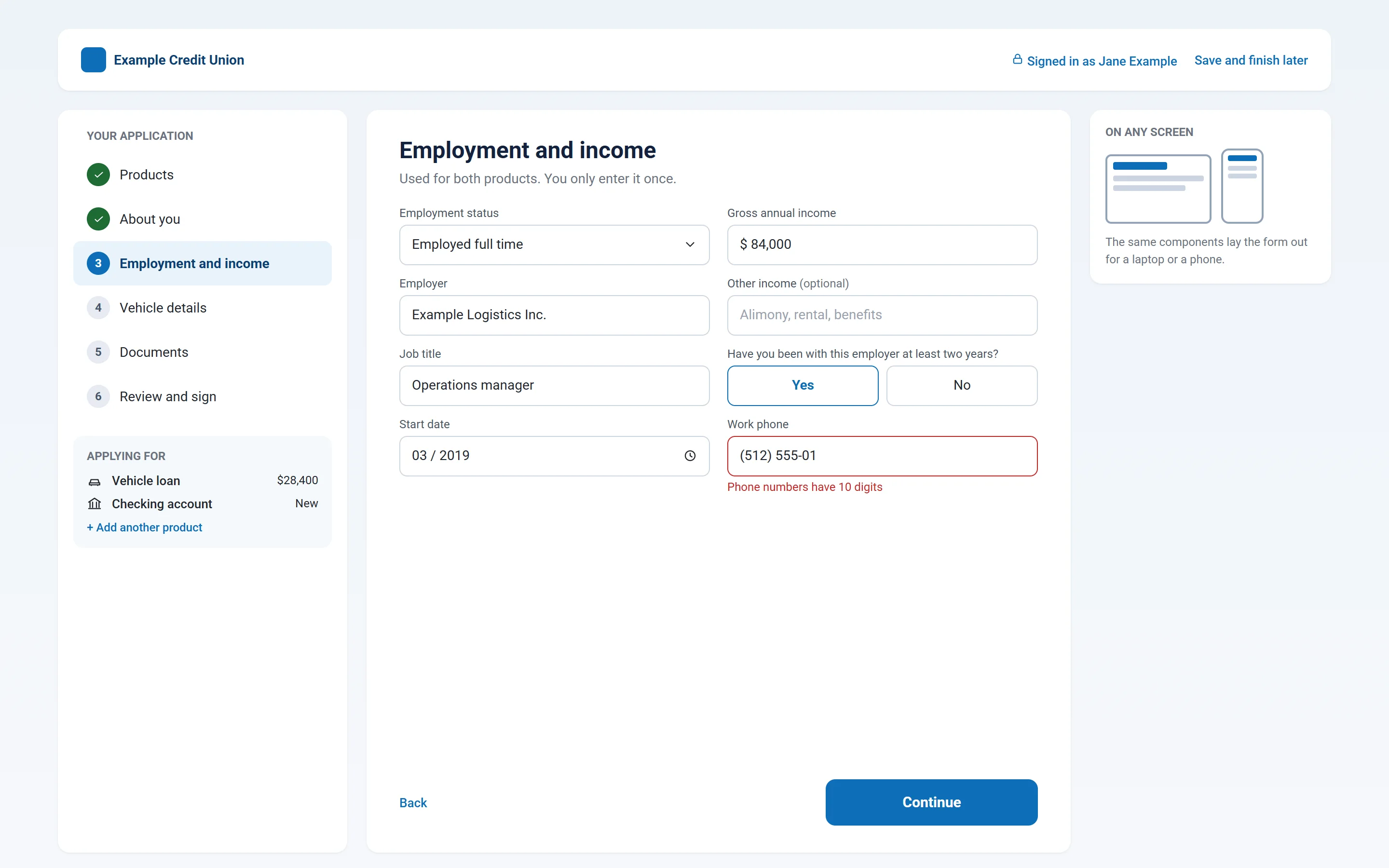
- Configurable fields, multi-product applications in one session, post-submission cross-sell logic, pre-qualification and pre-approval rules, and built-in validation to cut manual work.
- Applicant experience
- Prefill, save-and-resume, document upload, in-session identity verification and eSignature, and single sign-on so a member can apply for another product without re-entering anything.
- Where it went next
- In October 2023 MeridianLink launched Access, a fully configurable successor, and the product page now presents Portal's role through Access. My work was on Portal, from 2022 to 2024.
Swipe to see the whole screen.
Screens
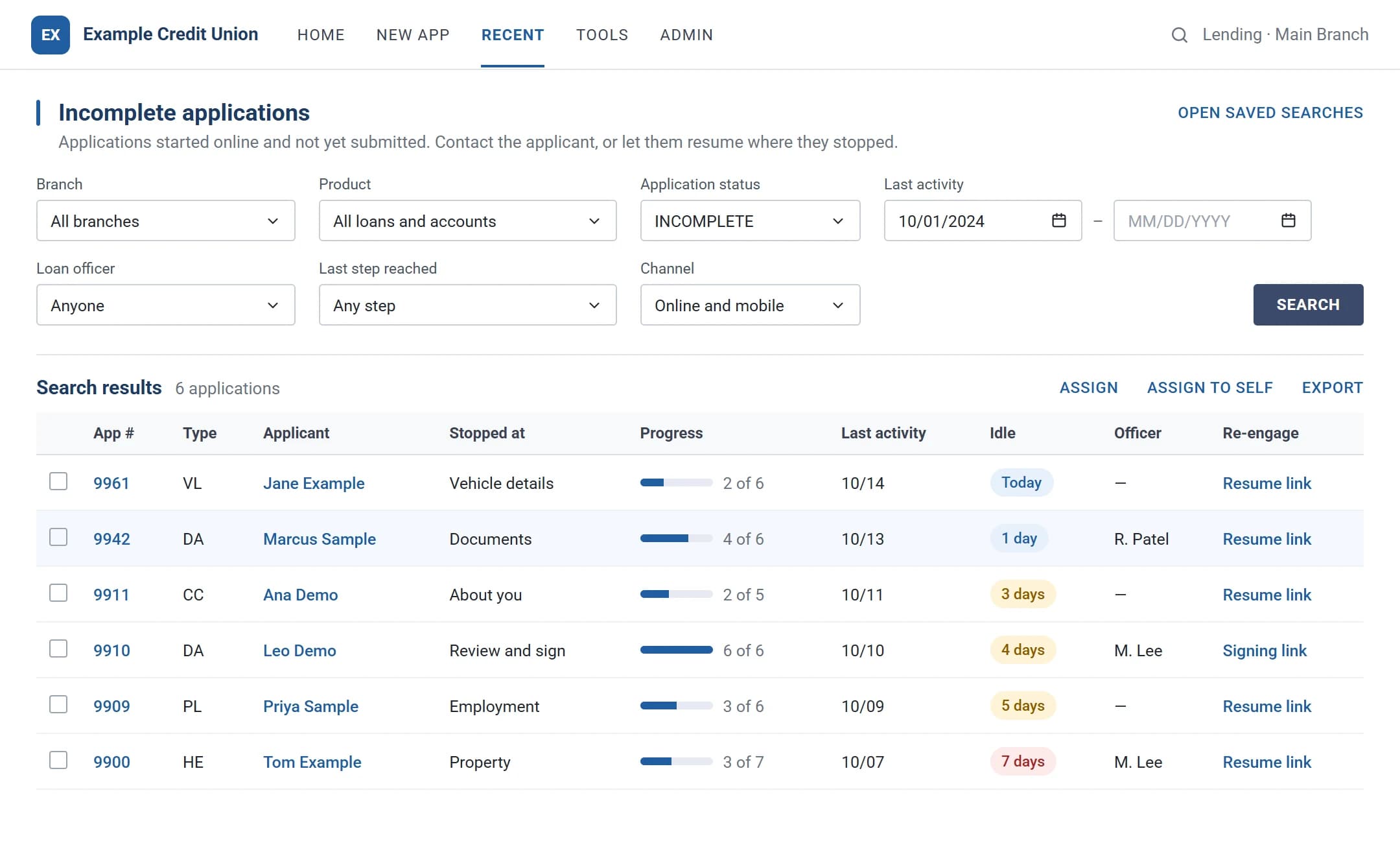
Two screens of Portal, drawn for this page with fictional data: the application on a phone, and a two-product application on a laptop. Pick a callout to see which part of the screen it explains.
Screen 1 of 2
The application on a phone
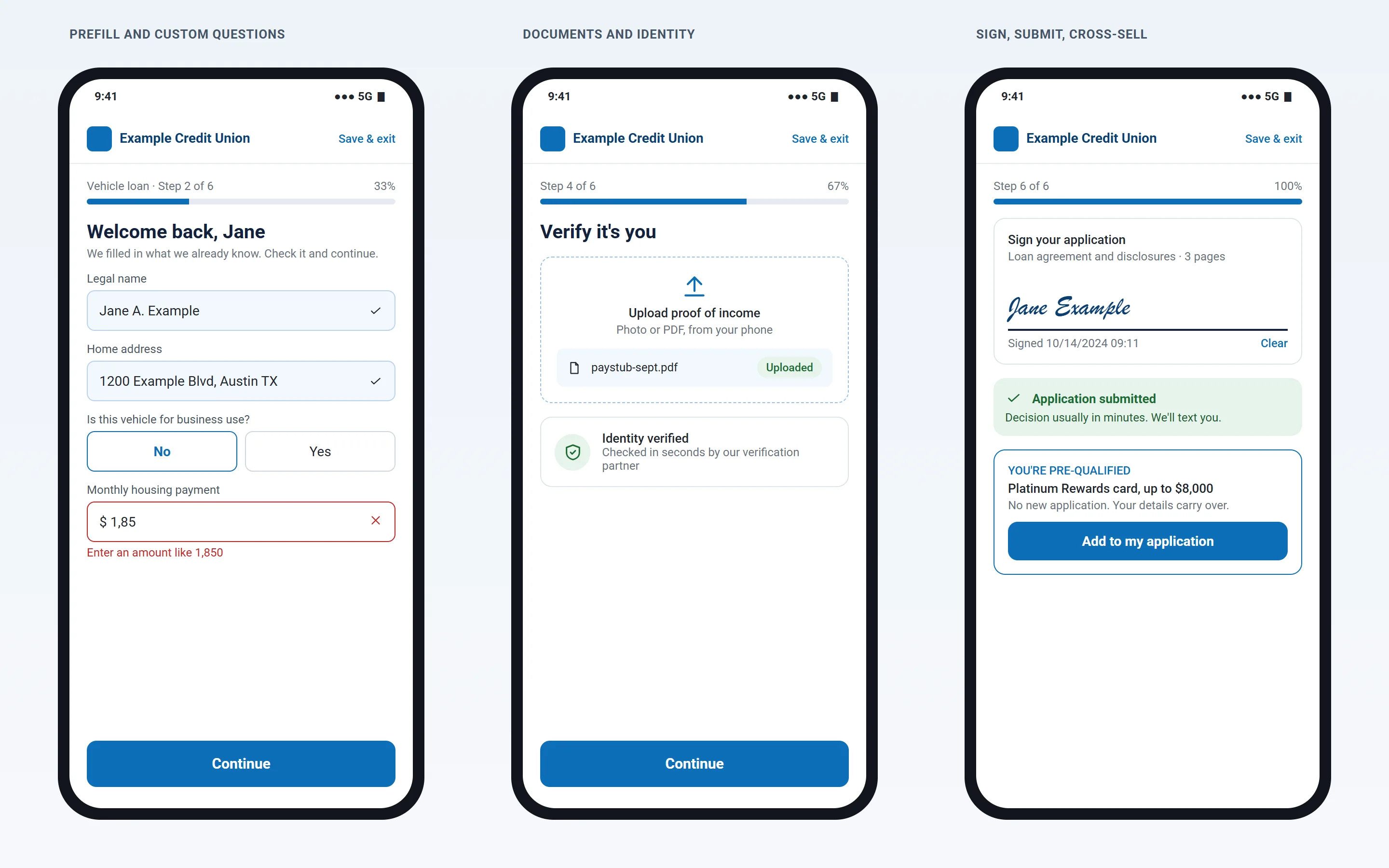
Prefill, custom questions, documents, identity and eSignature in one flow.
Three steps of a vehicle loan application as an applicant sees it on a phone: known details prefilled for a member, a lender-defined question, inline validation, document upload, identity verification in session, the signature, and a pre-qualified offer after submit.
Role
- Software engineer at Bhavna Software India, on MeridianLink's products from August 2022 to September 2024.
- Created core components, and coded across HTML, CSS, JavaScript (ES6 and later), TypeScript, React, C#, VB.NET and ASP.NET Core.
- Wrote maintainable, testable code with NUnit and Moq.
- Worked with the client on requirement analysis for stories and tasks, system design, and product enhancements.
- Managed deployments and monitoring through Azure Monitor and Azure Blob Storage.
Constraints
- Mobile-first flows that still had to cover identity verification, document upload and eSignature end to end.
- A security bar appropriate to a top US FinTech vendor, with Azure Blob Storage and Azure Monitor in the deployment path.
- Legacy VB.NET and MSSQL systems that had to be extended, not replaced.
- Applications submitted here land in Consumer and Opening, so every field had to mean the same thing on both sides.
Architecture
A mobile-first UI with configurable forms and cross-sells, over an ASP.NET Core API that owns workflow automation, with EF Core on MSSQL for application records. eSignature, identity verification and the MeridianLink Consumer and Opening products plug in alongside.
Key decisions
- Configurable application flows. Forms, cross-sells and verification steps are configuration, so a lender can change a journey without a release.
- Reusable React components. One component set across modules kept the UI consistent and let modules used by thousands of applicants ship on time.
- Request-cycle optimisation. API bottlenecks were addressed at the request and response level rather than hidden behind loading states.
- Working with the US teams directly. Refining legacy interfaces into modern ones went faster when the people who owned the old behaviour were in the conversation.
How I worked
- Straight from the client
- Requirement analysis for each story and task happened with MeridianLink directly, so system design and enhancement ideas came from the people who own the product.
- Sprint rhythm
- Feature planning, sprint discussions and peer code reviews, with work tracked in Jira and designs handed over in Figma.
- Tested as it ships
- Unit tests in NUnit with Moq for the services behind each change.
- AI assistants, used deliberately
- GitHub Copilot and ChatGPT to speed up feature work, troubleshoot issues and support code reviews.
Results
A smoother, more automated application experience aimed squarely at reducing drop-off: modules I delivered on my own, used by thousands of applicants, on one shared component set over faster APIs.
- 1,000+
- end users on modules I delivered
- 5
- applicant steps built into one flow
- 2
- years on the MeridianLink stack
Stack
- ASP.NET Core
- C#
- VB.NET
- Web API
- EF Core
- MSSQL
- React
- TypeScript
- JavaScript (ES6+)
- NUnit + Moq
- Azure Blob Storage
- Azure Monitor
- Jira
- Figma